Showing posts with label creative process. Show all posts
Thursday, September 11, 2014
Experimenting
This is my very first "public" painting. I have painted for many years, but kept my works private...hidden. I'm experimenting with different canvasses and paints. This is water color on cotton canvas. I used a partly Fauvist approach to some of my color choices and overly dramatized facial features. Kees van Dongen is my inspiration. See more of his works here (my favorite The Corn Poppy 1919) and here.
I sketched in pencil on the canvas before layering the watercolors on the rough surface. It was very interesting how the watercolor interacted with the cotton. Some colors worked better than others. Blue (turtleneck) and gray (background) were smooth going on, while brown was tough to apply evenly. I can't wait to try out some other techniques...just need to find the time!
Labels:
art,
art history,
artist,
artistry,
arts,
creative process,
creativity,
drawing,
fauvism,
fauvist,
matisse,
modern art,
moma,
painting,
post impressionism,
post impressionists,
water color
Thursday, September 4, 2014
Creativity
In honor of back to school, I'm posting a helpful paper I completed a couple of years ago on creativity. I hope it sparks your creativity. It may even be helpful information for your own paper. Have a great year and feed your imagination!
Psychoanalytic Theories of Creativity & Genius
by Amanda Gia
MLA: Johnson, Amanda Gia. "Psychoanalytic Theories of Creativity & Genius." Amanda Gia. Blogspot.com, 4 Sept. 2014. Web. Access Date.
An epiphanic thought came to mind after reading Carlisle Bergquist's article: The act of discovering the source of creativity is a creative process within itself. Which leaves one to wonder, if the progenitors of the three branches of psychology, Freud, B. F. Skinner, Rogers and others, would have attempted to uncover their source of creativity, would they have found the answer? They would have been their own best subjects. They would have known what happened immediately prior to an idea of greatness, what encounters sparked curiosity, and what emotional state they were experiencing when inspiration hit. Instead, they looked to the tenants of psychology to define creativity.
Psychoanalysis was too primal in its interpretation. Freud even acknowledged that psychoanalysis was not the solution to “elucidating the nature of the artistic gift” in his Autobiographic Study (qtd. in Bergquist). There had to have been a better explanation for the creative process than impulses and urges. If all of the creative people in this world were unhappy and unfulfilled, this world would be in an abysmal state. Behavioristic psychology is built on what is observable, and the source of creativity is definitely not observable. The behavioral processes and the ultimate products of creativity were studied, yet the source was still unidentifiable since it was an unquantifiable enigma. Lastly, the humanistic approach to understanding creativity drew near to the source because it clearly described the creative process, integrating aspects of both psychoanalytic (i.e., primary processes) and behavioristic (i.e., conditioning and positive reinforcement) in addition to declaring that creativity is what makes one human. Humanistic psychology best describes Albert Einstein’s creative process, yet still lacks to uncover the source.
Einstein’s “driving need to understand the logic of nature, tied to a breathtaking creativity and a fierce intellectual independence” were the catalysts for his work (Smolin 56). His “driving need” fueled his creativity and his creativity coupled with his intellect and hard work changed society. His process can be clearly observed through the humanistic integrated creativity lens. Yet, he had visions or “happy thoughts” while at his job at the patent office (Gribbin 39). Where did these visions originate? Was it his childhood imagination resurfacing at a time when he could infuse his vast knowledge to postulate and test theories of relativity? Or, was he just sleepy causing his brain to wonder which precipitated broad thinking (Diduch 9)? The source is still a mystery. Einstein’s ability to think on dual planes of thought by connecting a happy thought and the laws of physics can be characterized as “bisociation” as coined by Arthur Koestler in his 1964 book The Art of Creation (qtd. in Bergquist). Ainsworth-Land’s third order humanistic view best describes his creative process insomuch he was in constant harmony with physics. “Insightful solutions to problems often happen when people use knowledge that they did not realize would be valuable when they learn it” (Markman 52). As proposed by Smolin in “Why No ‘New Einstein’?” encouragement and funding should be given to scientists who are “independent thinkers” with “diverse points of view” who are committed to solving the untrendy problems “to ensure the progress of science is not stalled” (56-57).
The same sentiment should be expressed in the discovery of the source of creativity. Although the three branches of psychology describe the process, the origins of creativity in the human mind or, even in the human genome, still need to be unlocked. “The concepts, attitudes, and procedures employed are probably at fault and in need of being transcended in a fresh approach” (Ghiselin 3). This fresh approach should be one that studies the characteristics, habits, environmental factors, genealogy, nutrition, and spiritual life of all who are creative, no matter what they create. Whether the arts or psychology, the light bulb pops up over them all. Had the psychologists not precluded themselves from their own studies, it is quite possible that we would know what powers that light bulb.
Works Cited
Bergquist, Carlisle. “A Comparative View of Creativity Theories: Psychoanalystic, Behavioristic,
and Humanistic.” Vantage Quest for Creativity and Personal Transformation (1999-2000). Web.
14 May 2012. <http:// www. vantagequest.org/ trees/comparative.htm>
Diduch, Mary. “Four secrets of creativity: to get your mental engine humming ignore conventional
advice.” Psychology Today (2012): 9. Web. 18 May 2012. <http.// go.galegroup.com>
Ghiselin, Brewster, ed. Introduction. The Creative Process: Reflections on Invention in
the Arts and Sciences. 1952. California: University of California Press; London: University of
California, LTD, 1985. Print.
Gribbin, John, and Mary Gribbin. Einstein in 90 Minutes. London: Constable and Company Limited,
1997. Print.
Markman, Art. “Get smart: how to bulk up your creativity muscle.” Psychology Today (2012: 52)
Web. 18 May 2012. <http.//go.galegroup.com>
Smolin, Lee. “Why No ‘New Einstein’?” Physics Today (2005): 56-57. Print.
by Amanda Gia
MLA: Johnson, Amanda Gia. "Psychoanalytic Theories of Creativity & Genius." Amanda Gia. Blogspot.com, 4 Sept. 2014. Web. Access Date.
An epiphanic thought came to mind after reading Carlisle Bergquist's article: The act of discovering the source of creativity is a creative process within itself. Which leaves one to wonder, if the progenitors of the three branches of psychology, Freud, B. F. Skinner, Rogers and others, would have attempted to uncover their source of creativity, would they have found the answer? They would have been their own best subjects. They would have known what happened immediately prior to an idea of greatness, what encounters sparked curiosity, and what emotional state they were experiencing when inspiration hit. Instead, they looked to the tenants of psychology to define creativity.
Psychoanalysis was too primal in its interpretation. Freud even acknowledged that psychoanalysis was not the solution to “elucidating the nature of the artistic gift” in his Autobiographic Study (qtd. in Bergquist). There had to have been a better explanation for the creative process than impulses and urges. If all of the creative people in this world were unhappy and unfulfilled, this world would be in an abysmal state. Behavioristic psychology is built on what is observable, and the source of creativity is definitely not observable. The behavioral processes and the ultimate products of creativity were studied, yet the source was still unidentifiable since it was an unquantifiable enigma. Lastly, the humanistic approach to understanding creativity drew near to the source because it clearly described the creative process, integrating aspects of both psychoanalytic (i.e., primary processes) and behavioristic (i.e., conditioning and positive reinforcement) in addition to declaring that creativity is what makes one human. Humanistic psychology best describes Albert Einstein’s creative process, yet still lacks to uncover the source.
Einstein’s “driving need to understand the logic of nature, tied to a breathtaking creativity and a fierce intellectual independence” were the catalysts for his work (Smolin 56). His “driving need” fueled his creativity and his creativity coupled with his intellect and hard work changed society. His process can be clearly observed through the humanistic integrated creativity lens. Yet, he had visions or “happy thoughts” while at his job at the patent office (Gribbin 39). Where did these visions originate? Was it his childhood imagination resurfacing at a time when he could infuse his vast knowledge to postulate and test theories of relativity? Or, was he just sleepy causing his brain to wonder which precipitated broad thinking (Diduch 9)? The source is still a mystery. Einstein’s ability to think on dual planes of thought by connecting a happy thought and the laws of physics can be characterized as “bisociation” as coined by Arthur Koestler in his 1964 book The Art of Creation (qtd. in Bergquist). Ainsworth-Land’s third order humanistic view best describes his creative process insomuch he was in constant harmony with physics. “Insightful solutions to problems often happen when people use knowledge that they did not realize would be valuable when they learn it” (Markman 52). As proposed by Smolin in “Why No ‘New Einstein’?” encouragement and funding should be given to scientists who are “independent thinkers” with “diverse points of view” who are committed to solving the untrendy problems “to ensure the progress of science is not stalled” (56-57).
The same sentiment should be expressed in the discovery of the source of creativity. Although the three branches of psychology describe the process, the origins of creativity in the human mind or, even in the human genome, still need to be unlocked. “The concepts, attitudes, and procedures employed are probably at fault and in need of being transcended in a fresh approach” (Ghiselin 3). This fresh approach should be one that studies the characteristics, habits, environmental factors, genealogy, nutrition, and spiritual life of all who are creative, no matter what they create. Whether the arts or psychology, the light bulb pops up over them all. Had the psychologists not precluded themselves from their own studies, it is quite possible that we would know what powers that light bulb.
Works Cited
Bergquist, Carlisle. “A Comparative View of Creativity Theories: Psychoanalystic, Behavioristic,
and Humanistic.” Vantage Quest for Creativity and Personal Transformation (1999-2000). Web.
14 May 2012. <http:// www. vantagequest.org/ trees/comparative.htm>
Diduch, Mary. “Four secrets of creativity: to get your mental engine humming ignore conventional
advice.” Psychology Today (2012): 9. Web. 18 May 2012. <http.// go.galegroup.com>
Ghiselin, Brewster, ed. Introduction. The Creative Process: Reflections on Invention in
the Arts and Sciences. 1952. California: University of California Press; London: University of
California, LTD, 1985. Print.
Gribbin, John, and Mary Gribbin. Einstein in 90 Minutes. London: Constable and Company Limited,
1997. Print.
Markman, Art. “Get smart: how to bulk up your creativity muscle.” Psychology Today (2012: 52)
Web. 18 May 2012. <http.//go.galegroup.com>
Smolin, Lee. “Why No ‘New Einstein’?” Physics Today (2005): 56-57. Print.
Labels:
arts,
back to school,
creative process,
creativity,
english,
freud,
imagination,
psychoanalysis,
psychology,
thesis,
writing
Wednesday, April 2, 2014
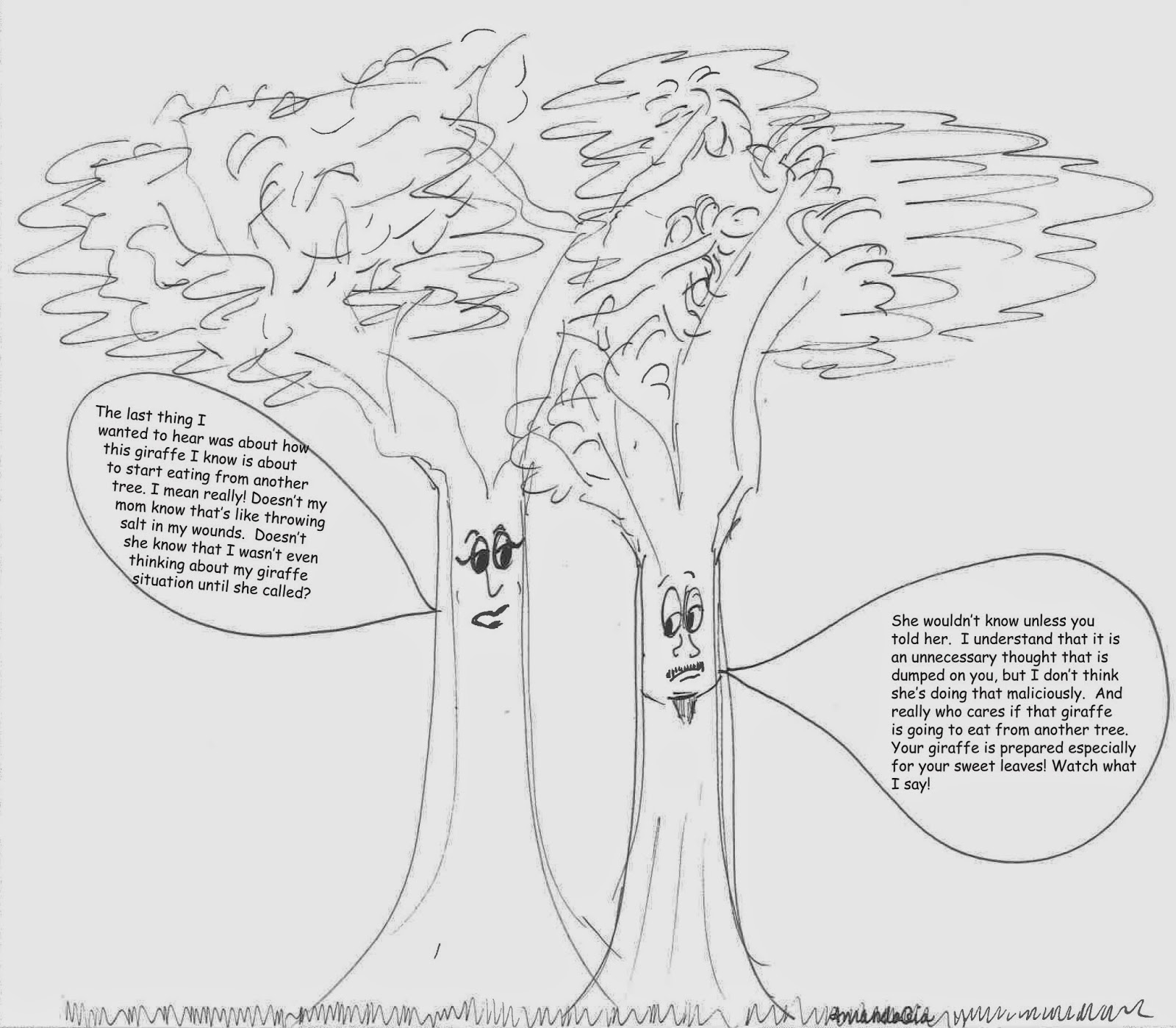
Salty Wounds
I’m trying my hand at developing a strip, comic and otherwise. The saga
continues with Miss Tree. She had to be reminded of her lack of a giraffe by
none other than Momma Tree. Momma Tree
means no harm, but salt is poured into the wounds nonetheless. Miss Tree is resilient. As this story will hopefully play out, she
will learn that if she accepts the wrong giraffe, she will not have any leaves
left for the giraffe prepared especially for her. At least that is what she reminds herself as she
waits patiently with her branches swaying in the breeze.
In other news, the editing of my book has hit a small snag:
I don’t have any time! I’m about five chapters in and have about 18 more to go.
I must say that the story line is consistent, and I have not run into any major contradictions. My character web looks like a mangled mess, but the character
relationships overlap nicely, and my main characters are clearly defined as
well as discernible. I just
want to make sure that there is adequate rise and fall throughout the book
which has become the most time consuming part of my editing process. I may be second
guessing my initial choices too much, but only time will tell.
Another hurdle in completing the editing of my manuscript is
the fact that as I read along, I have a mental flood of concepts for my next
books. I know what I would like the
characters to accomplish and experience next in their lives. I usually have to stop and take notes as the
ideas break through into my consciousness.
On top of the inspiration I get from the manuscript, I have daily occurrences
that just need to be shared…through my characters of course. I find that one never can expect what will
happen in this life. The human
experience is one that is learned while it is lived. I learned something very new today or maybe
it is old, but repackaged either because of time or because of my own level of maturity. I just heard on a prayer call (http://www.theprayercall.org/)
yesterday that at times, we pray for things in faith and when we look around, it looks as if the direct opposite occurs. So,
I learned today that no matter how antithetical a situation may become, God’s
hand will either fix what’s broken or give a completely different model. Not
profound in the least, but exactly what I need to hold fast to in order to get
the salt out of my wounds, whether the salt was poured by loved ones or ones
that I had hoped to love.
Labels:
artistry,
author,
comic strip,
comics,
creative process,
dating,
drawing,
faith,
moms and daughters,
patience,
prayer,
relationships,
writer
Subscribe to:
Posts (Atom)